Seeing names…

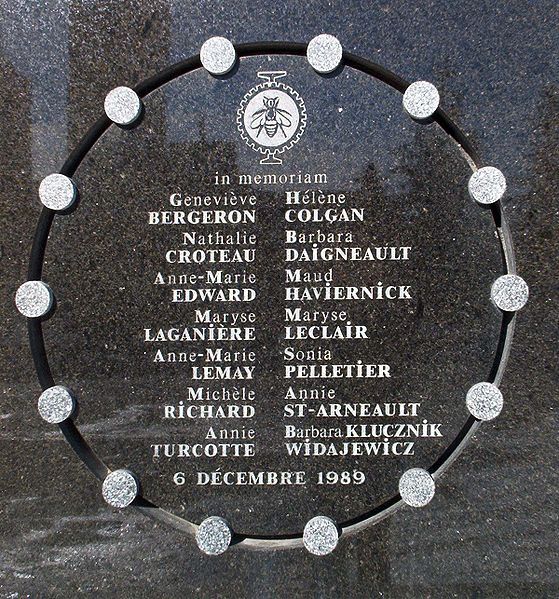
559px-mtl_dec6_plaque

I didn’t know these women, but I want to I remember them. 

This week marked twenty-three years of remembering a tragedy: in 1989, on December 6, a young man took a gun and a knife and went on a woman-targeted shooting spree at the École Polytechnique, here in Montreal.  The fourteen women named above were killed, fourteen more people were injured, and our nation was scarred.  The perpetrator was aiming at women because, as he wrote in his suicide note, he hated feminists, and more generally, women who worked in fields traditionally held by men. 

When this shooting took place, I was a girl with aspirations of going to university, and it seemed to me very scary and sad that young women in a university might be killed just because of what they chose to study.  A seed of fear was established: I could be selected as the target of violence because of my gender.  Especially if I chose to do things seen as challenging it.

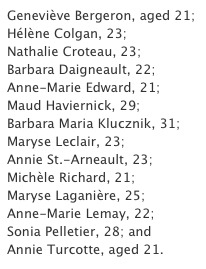
Events to commemorate this tragedy have kept me aware of it, at least annually, but this year several people, on the part of Facebook that I see, created an image that has the “Montreal Massacre” affecting me more this year than ever before.  What my Facebook friends did is this: they created lists of the names of each woman who died that day. 
Seeingnames_1

There has been a movement in recent years to name victims rather than perpetrators, to move the focus over to maintaining memories of the lives that were lost.  While I’ve liked this trend in concept, it has never previously had a strong effect on me.  But this year, seeing all of these names togetherin what has become a familiar online space—has been so effective. 
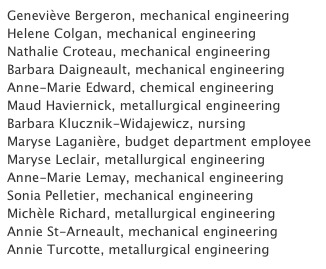
Seeing_names_3

Some posts were detailed, containing the women’s young ages, or their fields of study; other notes were simply a list of names.  It appears to me that no two of my friends just cut and pasted the names from the same location.  Each person used slightly different spacing or punctuation, and with those seemingly minor formatting techniques, they thoughtfully curated each alphabetized list.  I imagine these friends, at their computers, pausing, and with a quiet breath out, wishing that each woman’s fate had been much different.
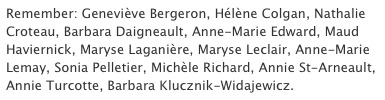
Seeing_names_2

Whether or not these imagined efforts actually went into the posts isn’t really the point; rather it’s that a set of names together, particularly in these memorializing circumstances, has such a strong visual effect.  It’s not just a reading of some letters that add up to names; there’s an overall significance to this imagea visual yet textual representation of humans—one that only names can create.  As another example, the Vietnam Veterans Memorial Wall is particularly compelling in a similar way: designed by Maya Lin, large slabs of polished black stone have been inscribed with nearly 60,000 names of veterans.  As you walk along this wall, the sheen of the stone reflects your image onto the names; the names are on you and you can’t shake them off.  
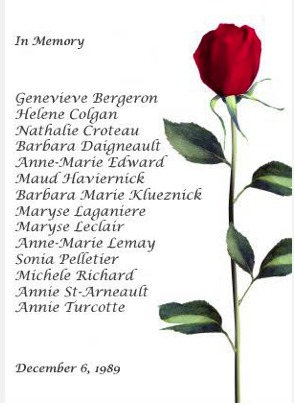
Seeing_names_4

Seeing the names of the victims of those violent acts on December 6th, 1989, brought my class lists to mind.  I teach communication courses to undergraduate engineering students at McGill, and semester after semester, I note how few women study engineering.  In my current classes of twenty-five students, generally, only two or three of those students are women.  So few!

Seeing the names of these women, who never got to carry on with their careers, has me thinking about what smart and tough young women they must have been.  If circumstances had been different, today these women would likely be established in their fields, and mentoring and leading younger women, like my students, to work in a field that isn’t easy by any stretch, but especially not as a woman.

What is it that you see in this list of names?

Geneviève Bergeron, Hélène Colgan, Nathalie Croteau, Barbara Daigneault, Anne-Marie Edward, Maud Haviernick, Maryse Laganière, Maryse Leclair, Anne-Marie Lemay, Sonia Pelletier, Michèle Richard, Annie St-Arneault, Annie Turcotte, Barbara Klucznik-Widajewicz
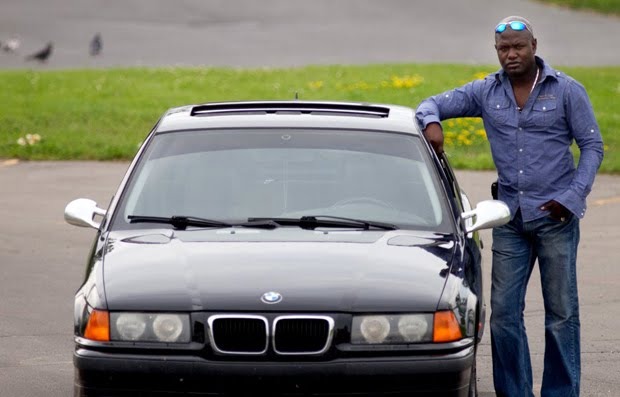
Why is a black man driving Joel Debellefeuille’s car!?

Debellefeuille

In Longueil, across the shore to the south of Montreal, a situation something like this unfolded in July of 2009…

A man is driving to get ice cream in a new black BMW. A police officer notices the car (it’s sleek! it’s hard not to!), and runs the license plate through his database. He sees that the name the car is registered to is that of Joel Debellefeuille.  He also sees that the driver is black.  Even though he doesn’t know Joel Debellefeuille, the office wonders, “Why is a black man driving Joel Debellefeuille’s car?!”  So, he turns on his siren, and for the fourth time in ten days, the man driving the new BMW is stopped by a police officer.  Frustrated, the driver refuses to produce his identification and he is charged with failure to do so, plus another minor infraction.

If you’ve been following this story, you’ll already know that the driver is Joel Debellefeuille.  And that he’s black and he owns a really nice car (both the man and the car are pictured above.)

You may also know that the case isn’t as “simple” as that of racial profiling: Mr. Debellefeuille wasn’t stopped just because he was a black man driving an expensive car.  (It’s not quite the same as when Henry Louis Gates Jr., also black, and a Harvard professor, was detained for what appeared to police to be  break-and-entry into a Cambridge, Massachusetts home, which turned out to be Dr. Gates’ own home: that was pure racial profiling.) 

Apparently in Debellefeuille’s case if, when the plate was run, it had been registered to someone with a “black-sounding” name, he wouldn’t have been stopped. But, what makes a name sound black, and what makes one sound Quebecois? Is a Quebecois name always French-sounding? Honestly, I’m not enough part of mainstream Quebecois society to know how common the surname Debellefeuille (or de Bellefeuille) is, or how most residents of Quebec would associate it. I’m guessing it’s not as common as Tremblay, but that it occurs.  And I’m also not sure how names sound “black” in Quebec. (Though the authors of this study have a sense for Boston and Chicago.) There are a number of Quebec residents of Haitian origin in Montreal, so maybe the police officers expected a Haitian-origin name? Or an African-sounding name, if one can generalize that there is such a thing as a name-type common to a whole continent?  Whatever the thought process, the officer(s) wrote at the top of the report that the driver was a black man with a “Quebecois name.”

In his defense, one constable stated that name incongruities are a basis for pulling drivers over (from the CBC website.): 

“If I run the plate and it comes back ‘Mr. Jack’ and it’s a woman driving, you know for sure she’s not the owner. That means I’ll stop her…. If I have an ‘Ebrahim’ and it’s a white man, a Quebecer who’s driving, yes. Or if it’s an Arab who’s driving and it comes back ‘Dubuc,’ ya I’m going to stop him and check.”

This scenario, which began more than three years ago, was in the news this week because in a Longueil municipal re-trial (ordered by the Quebec Supreme Court), Judge Tremblay(!) acquitted Debellefeuille and apparently chastised the officers involved.  In his decision, Judge Tremblay states, “The fact of falsely or ignorantly believing that the family name ‘Debellefeuille’ can’t be the surname of someone with black skin can only show a flagrant lack of knowledge about Quebec society.” And Fo Niemi, at the Centre for Research-Action on Race Relations, contextualizes the ruling in this way: “We’ve never seen a municipal court judge going this far in reviewing the state of Canadian jurisprudence and Canadian case law on racial discrimination, racial profiling.” (Quotes from the CBC website.) In these ways, and for Debellefeuille, the ruling is a victory.

Of course, I’m completely pleased with Judge Tremblay’s decision, but I don’t think the police officer’s mistake is that of a fool; rather, this is a common oversight in a culture that reads too much into names, often discriminating based on them, just as we do when we racialize people.

If a surname is the basis of a judgment, then that name is being relied on too heavily as an indicator of information about its bearer.  Part of the beauty of a name is that it is not a regular word: we can’t look up its definition in a dictionary once, and then expect it to mean the same thing every time.

So much depends on a surname! This time it’s Benhabib.

Djemila-benhabib

As many are well aware, Quebec has recently been through an election and the issue of insiders and outsiders, of protecting the status quo, has been illuminated.  Quebec’s identity was made an election issue by the Parti Québécois (PQ), particularly its leader, Pauline Marois, as she argued for maintaining some symbols of religion (i.e., the Catholic crucifix) that are part of Quebec’s established cultural heritage, while banning other religious symbols (such as the Sikh kirpan and Muslim hijab). (She has more plans, too, like Quebec citizenship.)

And then names became part of this debate…

In the middle of August, Djemila Benhabib (pictured above), an (as it turned out) unsuccessful PQ candidate, voiced her disagreement with Marois, by arguing for consistency with use of religious symbols. (Though she later rescinded.)  Around the same time, during a radio call-in show, the city of Saguenay’s mayor, Jean Tremblay, condemned Benhabib’s statement with this comment:

“What’s outraging me this morning is to see us, the soft French Canadians, being dictated to about how to behave, how to respect our culture, by a person who’s come here from Algeria, and we can’t even pronounce her name.”

Radio host Paul Arcand acknowledged Tremblay’s comments as racist and xenophobic and also told him how to pronounce Benhabib, but Mr. Tremblay continued, “They’re making our culture and religion disappear everywhere. You don’t realize that.” (This is excerpted from The Globe and Mail, August 16, 2012).

Trembaly’s concern with not knowing how to pronounce Benhabib’s name can be understood in more or less sympathetic ways.  1. We could feel for him, as one of Quebec’s dominant culture of “soft French Canadians,” for not being able to pronounce Benhabib.  2. But perhaps he means that someone whose name isn’t recognized, isn’t even pronounceable by him, should not be able to comment on directions forward for Quebec society, even as a potential elected representative.

Part of what is interesting here is how a name is called upon to determine who may comment on the maintenance of Quebec’s culture.  So much depends on a surname!

As well, Tremblay’s division between “us, the soft French Canadians” and “they” who are “making our culture and religion disappear” demonstrates a pretty intense insider/outsider demarcation.  For many residents of Quebec, in each of our particular positions, this difference exists as more of a continuum, not something so binary.

This interaction leaves me mulling some points: how does time figure into social belonging, into cultural representation?  Must a person who has immigrated always be an immigrant?

When can immigrating be seen as a verb, an action one takes, that we needn’t always define or be defined by?  After how many years in a country can one’s suggestions be considered relevant?  And shouldn’t that be based on the quality of your suggestions, not your last name?

Excerpted article

Contextualizing response from Antonia Maioni

Diane interviewed by OpenFile Ottawa

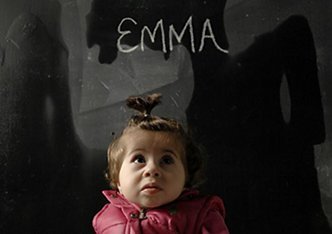
Emma5

As the open data trend gets going, residents of cities across Canada are making sense of all kinds of counts of their activities over time.  I think this local sensemaking is super interesting, and I like that comparisons (e.g., over time and between cities) can be made.   

The brief article I’m interviewed in was written after the top 10 selected baby names for Ottawa residents from 2005-2009 were “opened. “

The article describes new parents’ debating between choosing common names and more individualizing ones for their children.  My comments are based on interviews I undertook for my dissertation; I found that for people who migrate to Canada or who are second generation Canadians, even very popular names from other countries could be challenging to use at school and work in Canada.


Sadder, wiser modern [American] parents

Below, an interesting note about what seems to a North American trend in naming children. How does this compare to naming in other cultures?

Sadder, wiser modern parents

“Drawing on a vast store of baby name statistics, Laura Wattenberg of the Baby Name Wizard website highlights a sea change in the way we name our babies,” says The Boston Globe. “A century ago, we regularly named our children after important people; today, we rarely do. In 1896, for example, William Jennings Bryan lost the presidential election – and yet one in every 2,400 babies born was named Jennings or Bryan, putting both names in the top 300 for that year. William McKinley spawned a wave of McKinleys around the turn of the century. The effect wasn’t confined to politics. … Nowadays, Wattenberg explains, we’re far more cautious about naming our children after famous people. In the past, you could expect a spike in little Roosevelts or Hardings even while the big ones were still in office. Today, we wait until a president’s reputation has been decided; that’s why there are lots of little Reagans and Carters, but relatively few Clintons or Baracks. Similarly, we no longer like naming our kids after present-day celebrities, preferring Ava (fifth last year) to Angelina (86th). We used to indulge in ‘frank, public admiration,’ Wattenberg writes. Since then, we’ve wised up.”

from the Globe & Mail’s “Social Studies” on July 27th, 2011 


Whatshisname: Why people’s names matter in news reports

Whatshisface

This week, following the deaths of 76 people in Norway during two attacks made by the same individual, many news and opinion pieces are being written to contextualize and to offer ways of understanding what has happened. My post is a comment on one such op-ed, and I focus on common journalistic and news consumption practices related to personal names.

As I read this op-ed from the Globe & Mail, I was struck by the substitution of “the Norwegian terrorist’s” name, with the term “whatshisname.” It was intentional and it was interesting, not just for the reason the author intended.

Put briefly, the author’s message is that it’s time to stop giving this lunatic any more attention by using his name, though that argument got a bit muddled when the article went on to list the names of many other perpetrators of comparable violence.

What was interesting to me– as someone who studies personal names and particularly how we make sense of each other’s names– is that it made me want to see the subject’s name again. I’d looked at whatshisname’s name closely on Saturday when I first read the Globe & Mail’s coverage about the attacks in Norway, because I was I was trying to make sense of who this person was…

His name is Anders Behring Breivik, and before photos of him were available, news reports described him as an “ethnic Norwegian” as a way of explaining that he is Norwegian through and through, or Norwegian as we might imagine a native Norwegian to be (i.e., stereotypically blond-haired and blue-eyed). He was described this way to ensure he wasn’t thought to be someone whose family had migrated to Norway or a racialized citizen of Norway.  

This type of clarification might not have been necessary in Norway’s own press, where people are familiar with a variety of names of Norwegian citizens, so they could likely see his name’s significance immediately. In the Canadian media, (the Globe and Mail and the CBC being the messengers I am most familiar with), we often read descriptors of people’s citizenships and ethnicities so we can make sense of these details even if they have no bearing on the news story. They are used to explain the name: to give us confidence in our interpretation of a name, or to correct false assumptions. If name changes have been made they are generally reported, as well.

So, what to make of the reporting practice of noting individual’s ethnicities? I think it requires further investigation. For example, how has it changed over time, especially through the past twenty years as Canada’s population demographic has become much more ethnically diverse due to increased immigration? What exactly are our news media policies about reporting ethnicity and citizenship? Most significantly, are ethnicities and nationalities consistently reported?  

The descriptors that are included along with names do allow us to make make more precise classifications, and the name itself has less work to do in our quotidian classifications as we make sense of the world. That doesn’t seem like a bad thing. However, descriptors of ethnicity, citizenship, and even religion may also allow us to make shortcuts in understanding people’s circumstances and motivations, and to fall back to stereotypes that have worked for us before. That could–and often does–have negative consequences. But maybe we’d be making assumption based on names just as quickly if the descriptors weren’t present.

That this op-ed didn’t use a name might not work for the purposes its author intended, but it does give the reader pause to consider how rarely it happens that we aren’t given a name to read in terms of ethnicity, and potentially religion or nationality, to help us make sense of a news report. 

As the story of the tragedy in Norway has evolved, we’ve understood that names, ethnicities, and classifications based on them, do in fact play a role in what transpired. But clearly Breivik’s motivations lie with him as an individual, and have little to do with the descriptors that could go along with his name.